new to being an expat spouse, new to Turkey, new to Mummyhood, new to Vienna, pregnant again, Mummy of two, on the move again, living in Athens, living in Milano!
How ecologically green are you? Most of us try to use as few single-use plastic bags as possible. Yet, I for one, often forget my big re-usable carrier bags in the trunk of the car or even at home because most of the green carrier bags are big, ugly and bulky and don't fit into your purse (if they do, they won't be able to fit all your food shopping in). So unwittingly, I end up either having to pay for a carrier bag -paper in Switzerland, re-usable plastic at Spar in Vienna, re-usable plastic covered material in major supermarkets in France- or get a free plastic one (unfortunately most places in Switzerland). Even if I have managed to remember my bulky re-usable carrier bag, I end up with a couple of plastic ones when buying fruit and veg anywhere but a market, if only to weigh the fruit and veg. So much for saving the planet and thinking of my kid's future. Another inconvenience of most re-usable bags is that many cannot be machine washed so once you've spilled some yogurt, say, you can either through the bag out (paper) or have to scoop out the mess and wipe it with a cloth and that's a real pain in the tush.
So, I am thrilled, to promote (because I really think it's a very smart idea and anyone who knows me, knows I love smart inventions) and hopefully convince you to buy a Trolley Dolly bag so that you never have to use another plastic bag again. Because:
you will take this one with you when you food shop
it will fit and carry all the stuff you buy
it will even fit your parking ticket/tube card, pen, shopping list, I-pod...
it can be machine washed
it will not break
it is rather cute
you won't need to use any plastic bags (not even to weigh the fruit and veg)
Imagine the thrill at the till when you say; "no thanks, no bag required, I have what it takes".
Have a look at the below. It's Zoe, mother to three and the inventor of the Trolley Dolly Bag
We are surrounded by big companies that produce and sell "products that make every day better for the world's consumers” thereby "creating a world of difference in people's lives everyday”.
Billion dollar, often global brands in beauty care, health care, baby, family and household care. All trumpeting that sustainable development and corporate responsibility, are key. All claiming their first responsibility is towards those that use their products, (sorry, "high quality products") their employees, and the communities in which they work and live. Huge, successful, heavy weight companies all striving to make the world a better place. That's a lot of money, a lot of people.
I guess the environment is part of this better world they are making. The shared, global environment, we live in.
So why is it, that in today's modern world, inhabited by these huge, powerful, responsible companies, who prone sustainable development and create social corporate opportunities, why is it, that at the door of Europe, in Turkey, (and I'm pretty sure, the Balkans, Russia and other developing countries would be no different) I cannot find one single refill for my soap, shampoo, detergent? A refill, which has less wrapping than the actual tube or bottle used to market & sell the original product. A refill, which allows you to keep the previous packaging (hence causes less waste) can be more easily recycled, and is usually environmentally friendlier in its components. The technology exists. These environmentally “lighter” refills exist. The machines, the packaging, the prints. It’s all there. It's being sold in Western Europe and America, so why is it not used globally?
I discuss with my husband. Cost he says. I figured. But... does it not cost companies to fork out cash for their annual charities and philanthropic does? These activities have greater impact on the public; they yield better results in terms of image and reputation.
Sure, sponsoring the medicine that will make a sick child better, makes for touching pictures. But what's the point if the water the child will drink (if any is available), the food he will ingest, or the air he will breathe, are more lethal than the current illness.What's the point of so called developed countries using the environmentally less damaging products/packaging, and making efforts to recycle them, if the much larger rest of the world is not? Or cannot. (I have been looking for a place to dispose of my old batteries, and have still not found one after two months!)
So, mostly we are very short and near sighted. Gratification has to be immediate. We want returns on investment now. We don't look ahead (in time) or around (geographically). But the truth is, we live in a world where in part at least, our present and future inexorably depends on what other people do (and we to them…) Hence, no nation, can be free to act as it will, independent or sovereign in dealing with common, shared, global resources. Ditto for those big companies, and each and every one of us. I think everybody will agree that in the long term, the cost of environmentally irresponsible behavior is far, far higher than marketing and selling ecologically friendly products globally, even where it is not a pre-requisite for your product to sell or your company to be well perceived. Agreeing obviously isn’t enough.
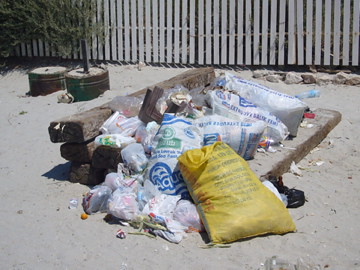
Coming back to my initial observation on not being able to find environmentally friendly products in shops, my husband comments:Nobody here even knows what caring about the environment is. Let alone recycling. Look at all these people just throwing out their empty beer bottles in the sea, their old sinks on the beach, car parts in the fields. They don't get it. As long as it's not in their face. And even when it is, they don't mind sitting on a beach next to rubbish. They don't see the equation of cause and effect - and they are not the only ones! He's right. It's amazing to us, but they do sit on beaches that we would consider garbage dumps or throw wrapping out of their car windows. Ok, so they need to be educated. It will take time, but it can be done. My husband is on a roll: In developing countries, ecology is a luxury. Economy (i.e. basic needs according to Maslow's pyramid) comes first. Economy, Ecology: opposing forces. I disagree.I think they are so linked that in today's world of economic rule, it has become an impossible luxury to ignore ecology. Amusingly, both terms go back to the Greek word oikos, (household); ecology is the logos (reason or logic) of the household, economy, the nomos (law) of the household. One would think, that reason and law should work together.
I'm not some big ecological nut. I don't know about all the polluting components of the products I use – and I’m sure there are many. Like most, I use what I think smells good, cleans well, etc. But I do, buy things that can be recycled, have less wrapping, and sprout the PET or other ecological logo. I try to remember to take my big IKEA bag when I shop food so as not to bring back dozens of plastic bags that I will not re-use. In Switzerland, I would sort and separate paper from bottles, aluminum from biodegradable waste. It was easy, there was an appropriate place for each type of waste, and so all I had to do was sort. The commune and canton did the rest.
In the German speaking parts of Switzerland, they made it economically sound for you to be ecologically responsible. Each citizen pays tax according to the amount of waste he produces. Initially, I am told, people would unwrap all excess packaging on the spot and leave it in the bins at the supermarket. Gradually, they started buying products that had "light" and "only-where-needed" packaging. Economic pressure on the consumer/buyer, developed into pressure on the producer/seller.
Similarly, tax incentives for green consumers or environmental initiatives are a growing trend and include deductible environmental cleanup costs, lower taxes on hybrid cars, or tax benefits for developing cleaner energy. Pollution tax and fines exist, and although they increase from year to year, too often they remain symbolic in many cases compared to the benefits incurred. More and more companies linked to environmental projects are quoted on key stock exchange markets. So, it seems, the door to ecological responsibility is economical -whether it's the carrot or the stick. The pull or the push.
Following this reasoning of Economy governing Ecology, (notice it’s law governing reason, shouldn't it be the other way around?) means that the same richer countries, (individuals and organizations) are paying poorer and ecologically sounder ones, to buy their unused "pollution points" (or “offsets”). So in practice, while in developing countries, wealth determines your “right to pollute” (in terms of “offsets” or just because you can easily afford the pollution fines or tax), you also pay more for products that are environmentally friendly (from your washing machine to ecologically engineered housing, or bio-food). Simultaneously, developing countries are continually sold the unwanted polluting goods for less.
It seems to me, that in developing countries, there can be no pressure from the consumer due to lack of awareness, education, and lack of infrastructure. So that leaves us with “push” or pressure on the producer/seller from the top down. Why is this is not happening?
For human beings who have the capacity to embrace abstract concepts like the “future”, (as opposed to other animals who live exclusively in the present) it shouldn’t be too difficult to grasp that it's like moving your waste from your front garden to your back door. It's the same garden. The same, common, shared planet. And what goes around, comes around. Any ideas for some environmental lobbying on a global scale?
This is a Flickr badge showing public photos and videos from NSDY. Make your own badge here.
Current favorites from Etsy
Thoughts I like
"The trick is to combine your waking rational abilities with the infinite possibilities of your dreams. Because, if you can do that, you can do anything." Anonymous
"good mothers come in many styles" - Amelia Maness-Gilliland